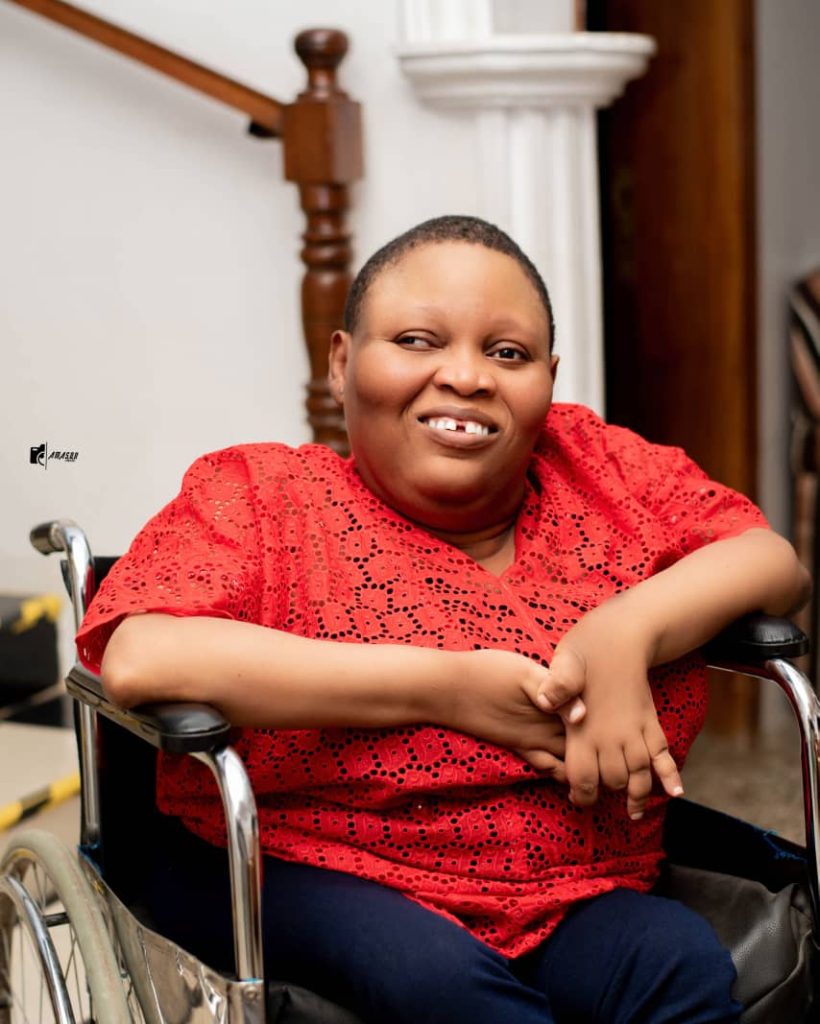
Meet Abiose Olufunke Falade.
Abiose Olufunke Falade is an editor, writer, and award-winning author.
She is the author of three remarkable books, with several other projects currently in development. She is known for her love and passion for culture—its relevance, the need for preservation, and its continuous existence.
Following the launch of her most recent book, Abiose shares insights into her stories, her audience, common misconceptions about her work, and the legacy she hopes to pass on to future generations.
Could you introduce yourself and trace back the specific internal or cultural catalyst that awakened your creative voice, transforming writing from a mere interest into a core part of your identity?
My name is Abiose Olufunke Falade. I am the second-born in my family.
What actually awakened my creative voice was nothing in particular—I’d say I was born creative, and I have been writing stories in my head for as far back as I can remember.
As someone with a disability, I’m mostly on my own—not just because of that, but also because I enjoy being alone. In my alone time, I become creative. I write from everything I see around me: the leaves, the animals, and moments that naturally turn into stories.
That is how I started writing.
I started by writing about children with disabilities like myself who possess special gifts. I’d like to say their disabilities and their gifts are completely different—poles apart.
Many creators view books as simple products, but your work feels driven by a larger purpose. What urgent social or cultural gap does your writing intend to bridge, and how do you use these narratives to pass the torch to the younger generation?
Right, my stories have a message behind them.
As someone with a disability, I know a lot of persons with disabilities who are lost and sad. Many of them cannot clearly see what tomorrow holds, and some do not even know what today holds.
One thing I try to change with my writing is to help people understand that no matter where they are, they have a RIGHT and they have a HOME.
Being disabled is not the subject matter of your life—it is just a part of your life. Beyond that, there are other parts of yourself that deserve attention and growth.
For me, when you read a story, you learn a lot. You learn what to do, what to say, and because of that, I make sure every story carries a message.
Most times, people with disabilities are more than their disability, and they should not be disrespected.
Because persons with disabilities often have negative representation in Nigeria, I decided to become a positive representative by writing positive stories about persons with disabilities—stories that allow them to be unapologetically themselves without ignoring the fact that they are disabled.
Looking at your broader journey as an author, what was the specific spark, real-world event, or unanswered question that made your latest project absolutely necessary right now, and who is the audience that needs to read it to feel seen?
I grew up in a world where persons with disabilities did not have representation. There were no books, no stories, and no heroes in Africa we could point to.
Okay, we could talk about Stevie Wonder—he was a Black American—and in Nigeria, people knew Cobhams, mostly through music.
I wanted there to be stories—fantasy stories.
For my books, I wanted disability to stand on one side and power on the other. I wanted the stories to have character and reflect how people live their lives on a daily basis.
My experience was growing up in a world where persons with disabilities were not seen, which made them seem like an anomaly whenever they appeared. They were viewed as strange or unappealing.
So I had to write from that side of the experience—people not seeing us as human beings but as something unfamiliar.
Unlike now, where people with disabilities are more visible, when I was growing up it wasn’t like that. Sometimes, parents hid children with disabilities.
For the lucky few of us whose parents chose not to hide us and instead embraced the reality of “this is our child,” life looked different.
That real-life experience made my project necessary.
I did not want any other child to go through what I experienced as a child—not being seen as a normal person.
“What does your actual creative ritual look like when bringing a book to life, and how do you navigate the tougher realities of the process—like emotional exhaustion or writer’s block?”
Naturally, my books take about two to three years to finish because I do not rush my creative instincts.
Sometimes everything comes to me at once. For example, with Book 2, I already had all the ideas before I even finished Book 1.
But for Book 3, I needed time. I needed to think deeply about the story.
There were periods when life took over and I could not write for months. For close to six months, I couldn’t write because I simply did not have the ideas.
Sometimes, I also rely on people around me to help me write because naturally, I cannot use my hands.
I think deeply about what needs to be told and how the story should move forward.
It’s important to have perspective when writing—to know where you are going and how you want to get there.
When I am emotionally exhausted or experiencing writer’s block, I take a break, step away from the story completely, and experience life as it unfolds because that is the only way I can create something that feels right.
How has your personal life journey directly bled into the pages of your work, and what is it about your specific lived experience that makes your storytelling perspective entirely unique?
Many people ask me which character I am in my books.
I am no single character.
Everything about me is poured into the books.
My determination is visible throughout the stories. One of the characters is especially determined—in fact, all my characters carry a no-retreat, no-surrender mindset.
Because I believe things should be done gradually and through process, that belief also appears in my characters.
We also have a father figure in one of the books—someone who is intentional with his words and values respect.
So yes, I would say a lot of me entered these books.
Is there anything people frequently misunderstand about you or the themes you choose to write about? Beyond entertainment, what is the single, non-negotiable truth you want readers to carry away from your work?
One misconception is that I am only writing about persons with disabilities and their challenges.
I write my books with the hope that people find them, find hope in them, and find peace while reading them.
Reflecting on your journey, what has been your proudest moment as a writer so far, and what next creative frontier or upcoming project are you currently building toward?
I have three moments that I am very proud of.
The first was when I wrote and published my first book. I was truly, truly proud of myself.
The second was when I won the Africa Laureate Award.
I was proud that my co-author, Tomisin Adeyefa, and I won the award because very few people noticed that we were the only disability representation on the list.
That became one of the proudest moments of my life because I felt I was one of the few people speaking for disabled individuals through my writing.
Another proud moment for me was graduating from university.
Those moments mattered because they were milestones I never imagined I would achieve.
So yes, I was really proud of myself.
Decades from now, if readers remember just one definitive thing about your footprint in the literary world, what should it be—and where can your community follow your work as that legacy unfolds?
Decades from now, I would like people to associate me with positive representation for persons with disabilities.
I want people to understand that I was never doing this for fame.
I genuinely want people—especially young girls and children, disabled and non-disabled alike—to understand that they have a voice and that they matter.
Not because of their disability, but because they are human beings.
And I would like to be remembered as one of the reasons they never forget who they are.